
Archive For The “Israeli Tech” Category

It’s that time of the year for the granddaddy of all consumer electronics shows, CES (International Consumer Electronics Show) to turn heads with groundbreaking innovations in Las Vegas. It’s the proverbial Disneyland for tech geeks and those more inclined to adopt early in the emerging technologies sector.
Here’s a flash summary of the top Israeli companies participating at CES and why their worth writing about. (Summary information originally published in NoCamels.com.)
- Edgybees, an American-Israeli startup founded in 2016 that combines AR, drones, computer vision, multi-sensor data analytics, and 3D video generation to improve “situational awareness” for rescue teams and emergency responders. Its real-time platform relays vital information over video captured by drones to help lead rescue efforts in natural disasters and public safety incidents.
- 2sens —A Tel Aviv-based company that developed computer vision tech for capturing 3D video and 3D graphics with smartphones.
Anagog — The developer ofJedAI , the first on-handset AI engine that converts sensors data in real-time and predicts mobility status and location information. The company has nabbed investments from Daimler AG and Skoda; Porsche Digital GmbH, a subsidiary that identifies trends and invests in startups for Porsche AG, purchased a “minority stake” earlier this year- Brodmann17 — A software technology company founded in 2017 that can run deep learning vision on edge devices. Its tech can be used in applications such as augmented reality, robotics, home security, smart cities, and autonomous vehicles.
- Byond developed a virtual reality publishing platform aimed at allowing “brands, media companies, and businesses to create their own interactive experiences.”
- CipherSiP, an Israeli-Swiss company that provides end-to-end communications and authentication solutions for connected mobility and industrial platforms, using watermarking technology.
- FireDome, a cybersecurity company that provides home IoT vendors with highly specialized, continuously evolving software solutions.
- Gauzy, an Israeli company with offices in California, Germany, and Hungary that developed patented Liquid Crystal Glass (LCG) panels. Gauzy combines high-tech and low-tech by embedding film technology into raw materials, like glass, to allow for control of various forms of light, where the surface can be switched from opaque to transparent on demand. The former is ideal for projection and privacy, while the latter invites the outside world in. Images and videos in HD quality can be projected onto the LCG, potentially turning any such surface into a projection platform.
- Gauzy Car Ads: Ads projected in a car window using Gauzy’s LCG technology.
- Hexa, a Tel Aviv-based company that uses a unique AI framework with a complex computer vision algorithm to reconstruct 3D assets from ordinary photos. The tech focuses on fashion, furniture, and electronics.
Lishtot , the award-winning Jerusalem startup that develops and builds products to detect for drinking water contamination and safety.Lishtot was named by TIME Magazine among 50 “genius companies” for 2018 and was selected among 15 “superhero” startups for NoCamels’ end-of-year review.- Lumen, an Israeli startup founded in 2014 that developed a single-breath device that tracks the metabolism for better nutrition and overall health. Lumen is currently crowd-funding on Indiegogo.
Nanoscent , a Haifa-based company that specializes in scent recognition technology, developing a sensor-chip and AI platform. Its first scent recognition app was for “match-making,” predicting a match likelihood based on skin scent.- NFT Inc, an Israeli company developing an autonomous, electric Vertical Takeoff and Landing (
eVTOL ) vehicle that would function as a car and a plane for two-to-four passengers. Qlone , a startup that has developed an app, based on five patented technologies, that allows users to scan real objects, using a smartphone camera, “modify them in app and seamlessly export the result” to a number of platforms “for 3D printing, 3D sharing, 3D selling or to use as a 3D asset in your game or app.” The startup has already partnered with LEGO and number of other companies for product launches.- Sixdof Space, a company that combines “optics, electronics, and algorithms in a single package for deployment in products currently in development in multiple industries – with an initial market focus on the VR market.”
- Superb Reality Ltd., a startup founded in 2015 that developed hand gesture control and motion tracking software solutions for AR and VR glasses and phones.
Syte ai, also a Tel Aviv-based startup that “combines object recognition, artificial intelligence, and machine learning” to make images and videos become instantly shoppable.Talamoos , a company developing prediction platforms based on AI’s machine learning and Big Data to track behavior. The startup participated in the first cycle of a unique accelerator launched Israel’s Internal Security Agency (ISA, also known as the Shin Bet in Hebrew) and TAU Ventures, the investment arm of Tel Aviv University.- TriEye, a startup founded in 2016 that is “developing technology to maintain smart and autonomous vehicle safety in adverse weather and low-visibility conditions. Its semiconductor design uses patent-pending technology that allows the production of shortwave infrared cameras at a fraction of their current cost.”
- Unbotify, which detects anomalies in human-device interaction using Machine Learning, in real-time on a specific user-flow.
Waycare , a company founded in 2016 in Palo Alto, CA with offices in Tel Aviv that leverages artificial intelligence and predictive analytics for proactive traffic management optimization. It recently made headlines for helping the city of Las Vegas improve road safety and reduce vehicle crashes by some 17 percent on a stretch of one of its busiest highways.- Woojer Ltd., a New York-based Israeli startup founded in 2011 that developed a “polyphonic haptic transducer that enhances music and audio.” The wearable devices (strap or vest) “accurately reproduce[…] bass frequencies and deliver[…] the emotional tactile sensation directly to the wearer’s body,” according to the company.
- OurCrowd, a leading global crowd-investing platform for accredited investors based in Jerusalem (and a NoCamels sponsor), also has a startup pavilion at CES 2019 with exhibiting Israeli startups that include:
- TechSee, an AI-powered visual customer engagement company that recently raised $16 million in a Series B funding round. Founded in 2015, TechSee developed a visual engagement solution powered by artificial intelligence and augmented reality that aims to revolutionize the customer experience, enabling consumers to receive augmented reality-based visual guidance through their smartphones from a virtual technical assistant.
Engie , a Tel Aviv-based startup founded in 2014 that developed an app that tracks car conditions and diagnoses malfunctions.- C2A Security, a Jerusalem-based cybersecurity company that combines large-system security, artificial intelligence, machine learning, and hardware and software security to develop solutions for connected vehicles.
Vayavision , a startup founded in 2016 that combines raw data fusion, AI and machine vision for a platform for autonomous vehicles that gives a complete environmental model outside a vehicle using a system of sensor technologies – LiDAR, radar, and camera. It recently raised $8 million in a seed funding round led by Viola Ventures, OurCrowd, and MizMaa Ventures, with participation from LG Electronics, and Mitsubishi UFJ Capital.
A few dozen more Israeli Startups had booths at the show as well, including MobileEye, Arbe Robotics, Arberobotics, Karamba Security, Innoviz Technologies, Mantis Vision, Valerannn, and Temi.

Diane Israel is a Chicago native and long-time supporter and advocate of the American Israel Public Affairs Committee (AIPAC). She is also famous for her culinary recipes. Diane can be reached at Diane@IsraelOnIsrael.com
Learn more about Diane Israel. Also, see Diane Israel on LinkedIn.

Courtesy of NoCamels.com, here’s the list of top Israeli movers, shakers, and influencers for 2022 spanning the arts, sciences and just about everything in-between.
Nuseir Yassin, aka NAS Daily
With over 11 million Facebook followers, it’s hard to miss one of the 1-minute, often-charming videos posted daily by Nuseir Yassin, better known as NAS Daily (“Nas” means “people” in Arabic). Yassin grew up in the northern Israeli-Arab city of Arraba and went on to study at Harvard before becoming one of the most successful content creators on social media over the past two years.
Alyne Tamir, aka Dear Alyne
Any fan of NAS Daily has seen and heard Alyne Tamir, Yassin’s American-Israeli girlfriend and travel companion, who appears in a majority of his videos. But she is also an authentic, master creator in her own right.
Netta Barzilai, Winner of the Eurovision 2018
Israeli singer Netta Barzilai shot to international fame after clucking her way to first place in the 63rd annual Eurovision international song contest (much to the bewilderment of Americans). Her female empowerment hit “Toy” for the #MeToo era resonated with audiences and she earned Israel its 4th win in the contest since its debut in 1973.
Erel Margalit, Social and Tech Entrepreneur
Dr. Erel Margalit is one of Israel’s most prominent social and tech entrepreneurs and venture capitalists. The founder and chairman of Jerusalem Venture Partners (JVP), which invests in and builds startups, he also served in the government as a Knesset member for the Labor party in 2015-2017
Lior Raz and Avi Issacharoff are known to international audiences as the co-creators of the wildly popular, award-winning series “Fauda,” which first premiered in Israel in 2015 and on Netflix in late 2016. The show portrays the complicated conflict between Israelis and Palestinians through the story of an Israeli counter-terrorism unit operating in the West Bank and trying to capture (or kill) Hamas terrorists.
Dr. Tal Rabin heads the Cryptography Research Group at the IBM T.J.Watson Research Center in Yorktown Heights, NY. She grew up in Jerusalem and earned a PhD in Computer Science from the Hebrew University of Jerusalem, after which she pursued an NSF postdoctoral fellowship at the MIT Laboratory for Computer Science.
Hossam Haick, Award-Winning Scientist
Professor Hossam Haick of the Wolfson Faculty of Chemical Engineering at the Technion – Israel Institute of Technology is the developer of a unique technology enabling medical diagnoses based on breath.
Dr. Orna Berry is an award-winning scientist, high-tech entrepreneur, and senior executive with over 30 years experience in the tech and science fields. A leading businesswoman dubbed the “first lady of Israeli high-tech,” she was Israel’s first (and only, so far) female chief scientist at the Economy Ministry’s Israel Innovation Authority, serving in that role in the late 90s
Professor Yuval Noah Harari is the best-selling author of the 2014 book “Sapiens: A Brief History of Humankind,” which shot him to fame and is set to be adapted into a movie. The book focuses on human history within the framework of evolutionary biology, tracing the evolution of our species to the modern age and has sold some 10 million copies in over 50 languages.
Linoy Ashram and Sagi Muki, Star Athletes
Rhythmic gymnast Linoy Ashram thrilled Israelis in August this summer when she broke the world record in the clubs-handling round at the Rhythmic Gymnastics World Challenge Cup in Minsk, and then went on to win gold in the
Learn more about Diane Israel. Also, see Diane Israel on LinkedIn.
Israeli judoka Sagi Muki, meanwhile, generated headlines for two reasons this year. First, he won two gold medals, one at the 2018 European Championships for the under-81 kg class, held in Tel Aviv in April, and a second at the Judo Grand Competition held in Abu Dhabi in October. Second, he participated in the latter competition wearing an emblem of the Israeli flag in an Arab country (amid threats from the International Judo Federation), and for the first time ever, the Israeli national anthem was played – a historical moment for all Israelis.
Eyal Shani and Yotam Ottolenghi, Celebrity Chefs
Israeli celebrity chef Eyal Shani is world-famous for his signature dish – roasted cauliflower – and stands behind the Miznon, a popular Tel Aviv restaurant, which he then took to Paris, Vienna, and Melbourne. This year, the Miznon made its debut in New York, bringing Israeli high-end “street food” to the Big Apple.
Israeli-British chef Yotam Ottolenghi, who co-wrote the best-selling book “Jerusalem” with Sami Tamimi, has a similar take on the evolution of Israeli cuisine.
Gal Gadot, Wonder Woman
Israeli actress and model Gal Gadot, famous worldwide for playing Wonder Woman, was selected by TIME magazine this year for its annual list of 100 most influential people of 2018
Adam Neumann, ‘We’ Entrepreneur
Another return entry is Israeli-born WeWork co-founder Adam Neumann, who was also listed this year in TIME magazine’s “100 most influential people of 2018” for “revolutionizing the way we work and reimagining how we live.”
Diane Israel is a Chicago native and long-time supporter and advocate of the American Israel Public Affairs Committee (AIPAC). She is also famous for her culinary recipes. Diane can be reached at Diane@IsraelOnIsrael.com

Real issues remain with mass acceptance blockchain technology beyond early adaptors and those with enough political capital include it in the development portfolio, usually one
The remainder of this post was excerpted from original reporting in NoCamels.com
Startups in the sector are expected to continue to multiply and developers and academics are being relied on for new, transforming uses for blockchain technologies.
“Israel is on the forefront of solving the real issues plaguing the blockchain world,” Josh Liggett, a
“Blockchain will be the next big thing in Israel because it mixes all the technologies that we have here including AI, IoT, cloud, cybersecurity, etc., we have them all. Most of the products blockchain needs are here. We’re well positioned and on the front line,” says Yael Rozencwajg, founder and CEO of Blockchain Israel.
If foreign investments are anything to go by, it would seem the global community agrees that Israel is a good place to look for blockchain innovation. This past year, European investment bank Benson Oak, Swiss VC fund Lakestar, and South Korea’s Kakao Investment, among others, have all put money in Israeli startups focused on blockchain.
“Under the radar, some of the top people in the world are investing in Israeli companies in blockchain. Ethereum Founder Vitalik Buterin, Polychain Capital, Naval Ravikant. These are high profile,” says Liggett, who blogs at OurCrowd about blockchain developments.
Israel secured numerous blockchain-related headlines in 2018 for its startups, ICOs, investments, and educational initiatives. Most of the headlines were positive but some Israelis were allegedly linked to the initial coin offering (ICO) scams.
While 2016 and 2017 were all about ICO offerings and new startups using crypto to raise funds, 2018 will be remembered as the year of the great crypto crash. Many of the startups that used crypto and blockchain technology to raise funds either turned out to be frauds or couldn’t deliver what they promised.
“The ICOs we saw in 2017 and 2018 are gone. They’re not coming back. This was a situation where you could say, ‘hey I might decide to open something, I’ll give you a token. If I don’t open, then too bad. There’s no recourse.’ You can’t do that anymore,” says Liggett. “ICOs are not coming back.”
The ICO crash, however, is seen by some industry experts as a way to clean the blockchain image and now propel it forward to the significant technology it can be for mainstream companies, charities and financial institutions.
“The Israeli blockchain industry is currently experiencing both a boost and a transformation. On the one hand, we see unprecedented growth among blockchain startups, but on the other hand, many of them are skipping ICOs in favor of equity financing. Today there are fewer startup founders coming out of morally questionable markets, such as Forex, binary trading, and gambling. Instead, more institutional players are starting to enter the market. Thus, the market is going through a self-purification,” Roman Gold, founding partner of the Israeli Blockchain Association, told Forbes.
Rozencwajg says blockchain technology will become a crucial part of everyday life.
She says fintech, medical and biotech, agriculture, and the gaming industry will show the greatest benefits from blockchain technologies in the coming year. “We need blockchain to secure all the networks,” she explains.
Blockchains record, collect and transfer all sorts of data. Industry experts believe that it is only a matter of time before blockchain platforms will be used for asset management, insurance claims, cross-border payments, property rights and real estate contracts, healthcare management, music ownership rights, voting, and a host of other possibilities.
Israel has some 300,000 developers, according to Blockchain Israel, and many are working on enterprise web application, advanced solutions and blockchain and crypto technologies.
“It will take some time for people to understand how truly powerful this technology is. There are so many technologies that still need to be developed,” says Liggett.
The OurCrowd analyst sees 2019 as a year to tweak blockchain protocols as opposed to implement the technology into new sectors.
“I don’t think the solution will come in 2019. I think Israel is going to work more on the technology because blockchain is a protocol, people will work on the technologies. Once the tech is established, people will build on top of it and apply it to different industries. I don’t think the focus will be on sectors, I think the focus is on underlying tech,” he tells NoCamels.
Liggett says some names to keep tabs on in the coming year include: Technion professor Eli Ben-Sasson, who co-invented Zerocash – a privacy-preserving cryptocurrency, and co-founded the startup behind its implementation – Zcash; Maya Zehavi, blockchain entrepreneur and a founding board member at Israeli Blockchain Industry Forum; Gal Landau-Yaari, former acting CEO of the Tel Aviv Stock Exchange, who is researching blockchain technologies and cryptocurrencies, governance of emerging technologies and financial stability at the University of Haifa; and Yonatan Sompolinsky, a PhD candidate, and Dr. Aviv Zohar, both of the Hebrew University, who proposed the GHOST protocol.
“These are the people who are busy working on building the next big thing [in blockchain],” says Liggett.
Diane Israel is a Chicago native and long-time supporter and advocate of the American Israel Public Affairs Committee (AIPAC). She is also famous for her culinary recipes. Diane can be reached at Diane@IsraelOnIsrael.com
Learn more about Diane Israel. Also, see Diane Israel on LinkedIn.

Startup Genome’s 2019 Global Startup Ecosystem Report (GSER), one of the world’s most comprehensive reports on startup ecosystems and subsector trends, firmly states that there will be no “next Silicon Valley.”
Instead, there will be 30 “next” hubs throughout the world that don’t quite achieve the density of the Bay Area, but do go beyond “critical mass” driven by regional or sub-sector leadership, the report explains.
Among them are New York City, London, Beijing, Boston, and Shanghai, five cities the report claims to have as much VC funding in startups as Silicon Valley had in 1998. But also on the list – in sixth place overall – is Tel Aviv, Israel’s finance and tech capital, which has helped earn the country’s reputation as the “Startup Nation” with more startups per capita than anywhere in the world.
The report, released in May this year and published annually since 2012, is a joint effort between Startup Genome, a management consulting firm that advises startups, and the Global Entrepreneurship Network (GEN), a producer of projects and platforms for entrepreneurs in 170 different countries. Startup Genome has collaborated with more than 300 partner organizations for over a decade and has collected data on over a million companies across 150 cities.
The 2019 rankings included a total of nine “success factors” that were used to evaluate the ecosystems: performance, funding, market reach, talent, experience, connectedness, knowledge, infrastructure, and policy. After being evaluated by these factors, the startup ecosystems are classified into four general types: leaders, major hubs, momentum, and challengers.
The report dubs Tel Aviv and other cities in the top seven as “leaders,” noting they have “strong performance across many ecosystem success factors, each of them creating at least $30 billion in ecosystem value, with a median of $56 billion.”
Tel Aviv came in sixth behind Silicon Valley, New York City, London, Beijing, and Boston. Los Angeles is on its tail in seventh place followed by Shanghai, Paris, and Berlin, all classified as “major hub startup ecosystems.”
“Tel Aviv’s startup ecosystem is one of the most highly developed in the world. Israel has more startups per capita than any other country and its startups collectively raised $6.47 billion in 2018,” the report quoted Uzi Scheffer, CEO of Israeli-founded global innovation platform SOSA, as saying.
The city received top marks for a number of “success factors,” ranking in the top tier for connectedness, referred to in the report in terms of links the city has to other top global ecosystems, and knowledge, as a result of “a culture of founders helping founders, frequent events, and entrepreneurs getting meaningful help from local experts and investors.”
Feature article: Artificial Intelligence.
Tel Aviv’s abundance in tangible IP, in the form of patents, research, and favorable policy environments leads to its strong performance in the knowledge category, according to the survey. In the IP commercialization sub-factor, Tel Aviv scored 10 (out of 10).
The city also ranked in the second tier for performance, talent, experience, funding and market reach. Since Tel Aviv operates within a small local market, the ecosystem sells to global customers at high rates – over 50 percent of Tel Aviv’s startups’ customers are foreigners, the report says. A small local market facilitates an ecosystem’s globality and scale.
Diane Israel is a Chicago native and long-time supporter and advocate of the American Israel Public Affairs Committee (AIPAC). She is also famous for her culinary recipes. Diane can be reached at Diane@IsraelOnIsrael.com
Learn more about Diane Israel. Also, see Diane Israel on LinkedIn.

This article was originally posted by NoCamels.com
No matter how hard we try, living a sustainable life is a constant uphill battle. We carry around metal straws and reusable bags to cut down on plastic consumption, turn off the water while brushing our teeth to conserve, try to buy organic produce to support sustainable agriculture. And yet, we all have a carbon footprint – some negative environmental impact that is just unavoidable.
Our planet’s resources – clean water, soil, clean air – are not infinite and Earth Overshoot Day, when humankind will have used up its allowance of resources for the year (according to calculations by the Global Footprint Network, a sustainability-focused think tank), was marked earlier this week. Five months early.
Israeli entrepreneurs Jonathan Haran and Victor Hajaj want to see drastic transformation in how we think about resources and consumption rates. And they’re aiming to effect this change on the societal and communal level.
Featured article: Artificial Intelligence on facial recognition.
“All the resources we need for living are part of the food-water-energy-nexus,” Haran tells NoCamels in a phone interview. “That’s all we need.”
Societies, he says, have just not understood this well enough yet, and so many municipalities, regions, and countries are managing the three realms independently of each other. “That’s inefficient because, on a macro level, food, water and energy really cannot be separated from each other. They are inseparably intertwined,” he explains.
The leapfrog in sustainability can therefore only come from an approach that sees this nexus as a whole, and enables innovation in all three sectors, he says.
Haran and Hajaj founded The Sustainable Group in 2017, an initiative that seeks to establish sustainable neighborhoods, with a focus on developing countries, while integrating technological systems “to provide for residents’ basic human needs without being dependent upon state infrastructures,” the group says. At a later stage, the systems may provide resources for the wider infrastructure network.
These technological systems include energy production systems (sun, steam, solar, hydrogen, turbines, wind, etc), food production systems (hydroponic greenhouses, aquaponics, permaculture and organics), water production and desalination systems, infrastructure and innovative sewage systems, computing systems that manage resources and report malfunctions, and construction and development systems, the group says.
Working with a team of top-notch scientists from different professional backgrounds, The Sustainable Group has developed two core products.
First is the “Village in a Box,” a complete, shippable construction set to build a fully integrated village with an infrastructure solution that supplies communities with housing, energy, food, and water.
“Especially in remote areas that have weak infrastructure, taking this decentralized approach can have a huge impact,” Haran tells NoCamels. By giving communities their own, independent water, energy and food supplies, residents can use renewable energy and tap into the synergy of systems to their full extent, growing food locally through vertical farming, putting the village’s waste to good use and recycling water, he says. It can be an incredibly efficient approach to resource management which directly translates into as much as a 35 percent decrease in costs of living, Haran adds.
“The questions we looked at were: What will the future of community and housing look like? What challenges will humanity face? Should our homes be flexible and smart and know how to work for us, to create economic and existential security for us? Yes! How do we do that?” Haran wrote in a Facebook post earlier this year.
The challenge, he wrote, is “how to deliver more infrastructure solutions that will keep up with the fast growth of population and know how to adapt to changes. Village-in-a-box is the future of communities. A community that is sustainable and resilient; productive and self-sufficient. It can be built anywhere on the globe,” he said.
And the model is not just for villages. After all, big population centers around the world are where most resources are squandered, and where fundamental change could have the greatest impact.
The Sustainable Group is offering its resource-distribution software as a separate service. The AI mechanism is designed to learn the behavior of both humans and the environment, to understand how everything works together, after which it will be able to tell the integrated food-water-energy-system how to use its current resources in the most sustainable way.
“With that, we can save 30 percent of wasted energy, which leads to an impressive cost reduction,” says Haran.
The software is still in development and “should be done by the end of the year,” Haran tells NoCamels. “This ‘software-only’ solution would be great for cities or for industry, basically for everyone who wants to apply real-time resource management.”
The Sustainable Group recently participated in the Chivas Venture Competition, a no-strings-attached $1 million contest first founded in 2014 for social entrepreneurs with big ideas for solving the world’s biggest social and environmental issues. The Israeli group made to the finals, but the top spot went to a project from Mexico that proposes to convert agricultural waste into a natural sugar substitute.
The Sustainable Group is now focused on a joint venture with the Arava Institute for Environmental Studies to build a neighborhood based on its proposed model as a sort of proof-of-concept. Construction is set to begin next year in a kibbutz close to Mizpe Ramon. The village has been dubbed “Qayma” for now and registration for the first carbon-negative village in Israel is open.
“That’s a great place to start,” explains Haran “since Mizpe Ramon is the most remote city in Israel. If it works here, in the middle of the desert, that’s great proof that it can work anywhere in the world.” And especially in developing countries where many people are at “the mercy of nature,” the group says. Humankind, they write, has already severely impacted natural systems through “air pollution, mining and as a result of the quick development of unsustainable energy based on fossil fuels, the destruction of the oceans of fish stocks, pollution of streams and deep aquifers, deforestation, harm to the food chain and natural ecology that plants and animals depend on.” This is especially felt in these countries.
Haran and Hajaj also want to show that living sustainably has nothing to do with being a “tree hugger,” as Haran emphasizes. “Sustainability is for everyone, and The Sustainable Group aims to give back control over resource consumption to the communities themselves. That is not just a selfless social endeavor, but also highly economical.”
The project is garnering interest in neighboring countries and communities in Israel, Haran says. Resource scarcity is especially pronounced in the Middle East. Haran tells NoCamels that The Sustainable Group is “already working with some Bedouin and Arab communities in Israel,” and would like to see more such cooperation in the future.
For now, the pilot project in Mizpe Ramon will be the next big step on the way to sustainable community living.
Diane Israel is a Chicago native and long-time supporter and advocate of the American Israel Public Affairs Committee (AIPAC). She is also famous for her culinary recipes. Diane can be reached at Diane@IsraelOnIsrael.com
Learn more about Diane Israel. Also, see Diane Israel on LinkedIn.

Israel’s Amos-17 satellite by Ramat Gan-based company Spacecom was successfully launched into space overnight Wednesday in Cape Canaveral, Florida. The launch, aboard a SpaceX Falcon 9 rocket, came almost three years after a spectacular launchpad explosion destroyed Spacecom’s Amos-6 satellite and the SpaceX rocket it was on in September 2016.
This article originally appeared in NoCamels.com
AMOS-6 was then touted as Israel’s most advanced satellite, operated by Spacecom and developed with its partner, the Israel Aerospace Industries. Its goal was to beam free internet across sub-Saharan Africa as part of a project with Facebook. The tech giant had in 2015 launched Internet.org, a non-profit initiative that would bring together technology leaders, nonprofit organizations and local communities to provide Internet access to the most remote regions of the world.
The Amos-17, built by Boeing, will have much the same objective: to provide satellite communication services including broadband and high-speed data services to Africa as well as the Middle East and Europe.
The satellite was originally scheduled to be launched on Saturday but was delayed to fix a suspected faulty valve during tests.
Once operational, Amos-17 will be the most technologically advanced satellite over Africa, providing extensive C-Band HTS capabilities, Ka-Band and Ku-Band to a range of markets, and combining broad regional beams and high throughput spot beams to maximize throughput and spectral efficiency, Spacecom says.
Amos-17 will operate from 17° East to expand and strengthen Spacecom’s coverage of the growing satellite service markets in the continent which suffers from snail-pace internet speeds and inadequate infrastructure. According to a 2018 joint report by the World Wide Web Foundation, the Alliance for Affordable Internet, and UN Women, internet penetration across the continent stands at 22 percent.
Featured article on artificial intelligence.
To get connectivity via Amos-17, a simple solar-powered terminal is required, the Times of Israel reported citing remarks at a press conference last month by Eran Shapiro, director of business and technology ventures at Spacecom.
Spacecom says the Amos-17 “will be a state-of-the-art multi-band high-throughput satellite, utilizing Boeing’s advanced digital processor platform, that will provide reliable and flexible satellite solutions and offer a significant competitive advantage for our customers.”
The satellite’s “inherent flexibility of the digital platform with a mix of fixed and steerable beams ensures a fast response to changing customers’ needs.”
The $250 million Amos-17 is expected to operate for at least 20 years.
Diane Israel is a Chicago native and long-time supporter and advocate of the American Israel Public Affairs Committee (AIPAC). She is also famous for her culinary recipes. Diane can be reached at Diane@IsraelOnIsrael.com
Learn more about Diane Israel. Also, see Diane Israel on LinkedIn.
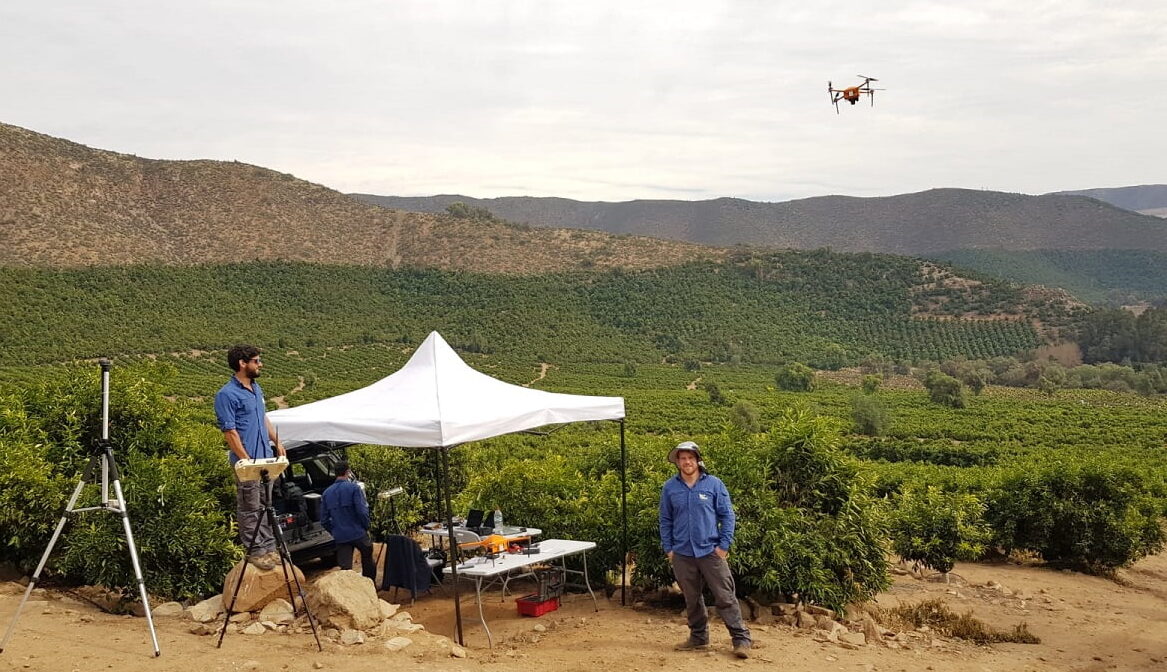
The integration of technologies such as satellites, sensors, and drones into agriculture and farming has contributed to some dramatic changes in these fields over the past few years. The ability to observe crops from a bird’s eye view and detect ground conditions for better productivity adds perspectives that once seemed impossible.
These tools and others like data technologies have been helping farmers and agricultural professionals gain insights, making the world’s most important industry operate more smoothly and efficiently.
This article was originally posted by NoCamels.com. See Featured article: Artificial Intelligence.
Follow Diane Israel on Facebook.
Follow Diane Israel on Instagram.
Follow Diane Israel on Twitter.
Connect with Diane Israel on LinkedIn.
Israeli entrepreneur Israel Talpaz has had an eye on these developments for years. He grew up on a kibbutz in the Sharon region with a father who was a professor of agriculture at Texas A&M before becoming the deputy head of the Volcani Center in central Israel.
Talpaz worked in the government sector for 30 years, overseeing multi-faceted, logistically challenging operations, before deciding to return to his farming roots with the insights he had gathered. In 2017, Talpaz teamed up with Barak Hachamov, an accomplished entrepreneur who recently served as an advisor for Google, to create SeeTree, an agriculture tech startup helping farmers manage and optimize the health and productivity of their trees.
Talpaz and Hachamov lead the young startup out of a beautiful, modern office overlooking the First Hebrew City, applying their business skills, logistical know-how, and passion for agriculture to solve some of the industry’s biggest problems – the modern management of trees and crops. The two knew that in Florida, for example, a state with a $10.7 billion citrus industry, a reported 80 percent of fruit trees were infected by deadly bacteria in 2015, leading to massive loss of production and revenue.
The founders communicated intensively with their early customers to understand what information drove their decisions and what it would take to provide a more complete picture to assist them. Concepts like optimizing irrigation on the level of an individual tree were previously inconceivable. Likewise, there was no way to accurately project crop yield before a harvest.
Initially, industry experts advised against the focus on trees; row crops are thought to be far easier to observe and analyze than trees which are larger and far more varied. Nonetheless, Talpaz and Hachamov pressed ahead and decided to bring the benefits of data, business intelligence, and first-rate technology into the fields.
Talpaz observes that agriculture is very similar to defense. “A big farm has a lot of threats and a limited amount of resources to effectively respond to them,” he tells NoCamels. “Farmers need to detect problems as early as possible if they want to succeed. Up until today they use their eyes and their feet to keep track of their crops,” says Talpaz.
Instead of using the good old “green thumb” that rules much of the agricultural world until this day, SeeTree uses technology to create a clear scoring system to evaluate the health of each individual tree as it produces.
“It was like trying to sell a thousand dollar iPhone to someone in the mid-90s who had only ever seen a flip phone,” Talpaz tells NoCamels of his early efforts to convince farmers to take the quantum leap in monitoring and optimizing the production of fruit.
SeeTree raised its early funds from local investors and had a viable product that was used by farmers in a pilot in California within three months of founding. The startup has since generated considerable traction— a recent $30 million investment round attracted significant investors in the agriculture industry such as Brazilian company Citrosuco, one of the world’s largest orange juice concentrate producers, Orbia Ventures, the corporate VC arm of Orbia (formerly Mexichem), which acquired Israeli drip irrigation company Netafim, and Kubota, a Japanese manufacturer specializing in tractor and agricultural equipment. The lead investor in the round was the International Finance Corporation(IFC), the private-sector arm of the World Bank Group.
“It’s all word of mouth. They call us. We are managing a waiting list to ensure that we can provide high-quality service and don’t overflow,” says Talpaz, explaining the critical importance of gaining the trust of farmers who have never employed advanced technology.
SeeTree’s solution relies on flying drones that provide high-resolution images and give a detailed aerial picture of orchards with a minimum of 700,000 trees. The drones scan 20,000 trees per hour and the images are analyzed carefully using machine learning to mimic an agronomist observing a tree. SeeTree gives each tree a score by checking for dryness, excess shade, weeds, bacteria, and other harmful actors that can interfere with growth. The score is comfortably accessible in a dashboard that the farmers use. This allows them to easily and intelligently activate their workforce and choose how to spend valuable resources such as water or chemicals
The drones work in tandem with a rover that drives through the orchards at night while using special, contrast lighting and computer vision cameras to get a clear, ground-level picture of the trees. The footage provides a fruit count, a better picture of the tree’s health, and an accurate prediction of crop yields before harvest. This gives a comprehensive picture of each tree and allows monitoring that helps salvage fruit before it is lost and, by extension, profit. Additionally, knowing the exact conditions in which the best trees grow helps farmers learn what works and optimize their treatment.
The footage taken by each rover produces one terabyte of data per night requiring advanced connectivity and cloud storage. The data from the rovers and drones is used in Israel by imagery analysts, software developers, and data scientists who manage the models that process the data. The teams then provide an aesthetic and intuitive platform for farmers to study their orchards down to the resolution of a single tree.
“It’s like an intelligence desk for farmers,” says Talpaz.
The insights gathered and provided by SeeTree are promising to an industry that has been rather slow to massively adopt advanced tech.
Farmers can now ask questions they didn’t know they could ask: How much viable fruit is growing in each section of an orchard or on a given tree before harvest? Where can early signs of bugs and bacteria be spotted? Which are the first areas that require manual labor to remove weeds or dead trees?
SeeTree currently has offices in Brazil and California to serve some of the world’s largest fruit-producing markets in North and South America. With its new funding, SeeTree says it plans to make high-impact improvements on its current offerings that will go towards enhancing the data-collecting operations by employing drones and rovers to capture more footage at once and operate for longer. In addition, there are plans to automate key elements of the service, allowing for swift growth as the startup expands into markets such as Europe and Southeast Asia.
With its unique solution, SeeTree is in the process of letting farmers worldwide reimagine what it means to manage an orchard.
Diane Israel is a Chicago native and long-time supporter and advocate of the American Israel Public Affairs Committee (AIPAC). She is also famous for her culinary recipes. Diane can be reached at Diane@IsraelOnIsrael.com

The COVID-19 pandemic has accelerated the need for more innovative and consistent distance learning methods in schools and universities. As education facilities across the world shuttered due to the global crisis, teachers and staff were forced to scramble together online learning resources and figure out ways to teach differently.
These changes were deeply felt in higher education as a new “hybrid” era of traditional teaching, online learning, and knowledge-sharing methods was conceived. While the idea of virtual education isn’t new — the first university to launch fully online degrees did so in 1989 — this mixture of in-person and remote education also demanded a “digital transformation.”
This article was originally posted by NoCamels.com. See Featured article: Artificial Intelligence.
Follow Diane Israel on Facebook.
Follow Diane Israel on Instagram.
Follow Diane Israel on Twitter.
Connect with Diane Israel on LinkedIn.
One organization that understood the need to embrace technologies to operate better long before the pandemic is Ex Libris, an Israeli company whose cloud-based solutions help institutions around the world improve their library management systems, research outcomes, and student engagement.
“We support higher education through its digital transformation processes and help institutes to integrate technologies in a way that helps those facilities improve their education and research performances,” Bar Veinstein, President of Ex Libris, tells NoCamels.
Ex Libris, meaning “The library of…” in Latin, began as an internal project at the Hebrew University of Jerusalem in 1980 to develop a new library management system, as no system was able to handle Hebrew and Latin character sets at the time. The software was called ALEPH (Automated Library Expandable Program.) Yissum, Hebrew University’s technology transfer company, founded Aleph-Yissum, a new company to commercialize the software, in 1983. Between 1983 and 1988, all eight universities in Israel bought the program and became part of a network. Aleph-Yissum started to sell the product abroad in 1989, mostly in Europe. By 1995, 200 libraries in 27 countries bought it.
Since then, the company was acquired four different times by American capital funds and companies, including the latest acquisition in 2015 by US firm ProQuest for more than $500 million, a purchase that was marked as the second-largest exit in the Israeli market that year
Today, Ex Libris is an Israel-based edtech company working with more than 7,500 academic institutes such as Harvard, Yale, and Oxford, in more than 90 countries
The company shifted to a SaaS (software-as-a-service) model back in 2010, as such solutions became increasingly more common due to their benefits for both software providers and customers.
Veinstein tells NoCamels that 100 percent of the company’s new sales are cloud-SaaS subscription.
“The thing that’s unique about how we moved to cloud is that the shift was done ‘organically.’ We didn’t acquire or merge with another cloud-based company in order to turn into one ourselves,” he says. “Our SaaS business model helped us to develop more efficient systems.”
Ex Libris offers SaaS solutions for the management and discovery of the full spectrum of library and scholarly materials, as well as mobile campus solutions that drive student engagement. The company’s products and services include four library management platforms, three discovery products, two resource sharing programs, a mobile campus solution, course resource lists, and a plethora of research, cloud, content, professional and support services
Alma, one of the company’s “best-known products” is a cloud-based library services platform that manages various tasks in a single platform.
“We usually refer to Alma as the ‘ERP’ (enterprise resource planning) system of libraries as it tracks down orders and bills, it manages print, electronic and digital materials and provides a cost-effective solution for libraries,” Veinstein says
learning remotely
Alma is currently used in 39 countries, among more than 45,000 librarians in 1,800 universities, the company says. During the COVID-19 pandemic, library staff were able to continue working remotely to support students’ online learning, even amidst social distancing or lockdown restrictions.
Another notable library-management product offered by Ex Libris is Primo, a system that gives access to the collections found in the library and helps better discover academic resources and scholarly materials. Ex Libris also provides resource sharing solutions that simplify the process of lending library resources between libraries, Veinstein says.
Veinstein highlights Pivot-RP, one of the company’s newest platforms, a global database of funding opportunities that facilitates access to funding for researchers. The company also recently launched CampusM, a mobile campus app and portal for students.
“The way I see it, these two products serve as a great example of how we, as a company, expand into new fields and lead innovation within the higher education – even outside of the library management context,” Veinstein says.
While Ex Libris is a longtime player in the burgeoning field of education technologies, the coronavirus pandemic has thrown even the most enduring companies for a loop.
“Like most tech companies, the sudden shift to remote work caught us by surprise. We had to close the doors of our several global offices and manage the work of over 1,000 employees from afar. I’m proud of how we [managed] to quickly adjust ourselves and move our customer engagement activity (sales, support etc.) to a virtual format,” Veinstein explains. “We recruited dozens of new employees that had never been to our offices, which is certainly strange. We still navigate our way through the new reality and try to figure out how to preserve our work culture and address the needs of our workforce within this bizarre situation.”
Veinstein says Ex Libris did have to make some changes to address the shift to remote mode, and these improved the company overall.
Diane Israel is a Chicago native and long-time supporter and advocate of the American Israel Public Affairs Committee (AIPAC). She is also famous for her culinary recipes. Diane can be reached at Diane@IsraelOnIsrael.com

TIME magazine has listed six Israeli-made innovations among its annual list of 100 Best Inventions of 2020 that are “changing how we live.” In 2019, the magazine featured nine Israeli innovations.
This year’s list was published late last week and features gadgets, devices, products, and services in multiple categories such as artificial intelligence, accessibility, electronics, augmented reality, design, finance, and entertainment. There is also a “special mention” category where one Israeli innovation was listed.
The magazine said the list was compiled through solicited nominations from TIME editors and correspondents around the world, and through an online application process. Each contender was then evaluated on key factors such as “originality, creativity, effectiveness, ambition, and impact.”
“The result: 100 groundbreaking inventions—including a smarter beehive, a greener tube of toothpaste, and technology that could catalyze a COVID-19 vaccine—that are changing the way we live, work, play and think about what’s possible,” the magazine wrote.
Among the best inventions were a power wheelchair accessory, a smart baby crib, an AR training platform for frontline workers, a made-to-order manicure service, a phone that doubles as a notebook by Microsoft, a robotic tutor, a vegan pork offering, and an indoor gardening solution.
Here are the six Israeli innovations that appear on the list:
Beehome by Beewise
Beehome, the first automated beehive created by Israeli startup Beewise, was listed in the artificial intelligence category.
Beehome is a solar-powered, retrofitted shipping container that can house up to 40 bee colonies in an automatically controlled climate for optimal humidity conditions that can be monitored via app. The beehome also has pest control functions that monitor for parasitic mites that can have detrimental effects on colonies. AI technology adjusts conditions in the Beehome when it identifies that a colony is preparing to swarm, and Beehomes send alerts to beekeepers once a container of honey reaches its 100-gallon capacity.
All of these changing conditions ensure that yields improve, pollination occurs more efficiently, and bee populations are protected. Beehome costs $15 per month per hive.
Israeli company Beewise created an autonomous beehive. Screenshot
The Beehome is a welcome development in a world where global bee populations have been declining over the last few decades. Bee populations often face colony collapse disorder, which occurs when the majority of worker bees in a colony disappear and leave behind a queen and a few nurse bees to care for the queen and the remaining immature bees. This disorder, on top of excessive use of agricultural chemicals and climate change, has significantly reduced bee populations, yet agricultural production must grow by 70 percent by 2050 to avoid food scarcity.
Beewise raised $10 million in funding in July for its innovative solution.
Trialjectory – a guide to cancer trials
TrialJectory, a startup launched in 2017 with offices in Tel Aviv and New York, also appeared in the Ai category on TIME’s list. The company has set out to optimize clinical trial matching for cancer patients.
CEO and co-founder Tzvia Bader has had extensive experience in the high-tech sector, particularly in big data, and conceived of the idea for TrialJectory after her own struggle with cancer.
The service she helped develop uses AI algorithms to sift through a myriad of available trials and produce recommendations for patients looking to participates.
Patients can log in to the company website and submit information on their particular situations. Bader told NoCamels in 2018 that one of the difficulties with trial matching is that the criteria are “very specific,” differing on cancer type and phase as well as other features peculiar to each patient. She said TrialJectory is able to achieve such precision: “Based on the patient profile we have, we run an algorithm to find the right trials so instead of a list of a few hundred, you’ll end up with two, three, [or] five that are right for you.”
The company generates revenue from pharmaceutical companies running trials to which TrialJectory refers patients. “As a principle, our mission, part of our values, we don’t charge the patient,” Bader said at the time. After TrialJectory returns trial recommendations on a patient profile, the patient can select one. The company then contacts the pharmaceutical company running the chosen trial to arrange for participation.
Augmedics
Xvision by Israeli company Augmedics featured in the Augmented and Virtual Reality category of TIME’s list.
The device is an AR headset with goggles that projects an “x-ray vision”-like 3D visualization of the spinal anatomy of a patient in real-time for surgeons. This allows the surgeon to accurately navigate instruments and implants while looking directly at the patient, rather than at a remote screen.
Augmedics was founded in 2014 by Nessi Benishti and Nissan Elimelech. The Xvision received 510(k) clearance from the US Food and Drug Administration last year.
“Augmedics’ mission is to give surgeons more control by creating technological advances that cater to their needs and fit within their workflow,” said Elimelech, who serves as CEO, at the time of the FDA announcement.
“Xvision is our first product of many to follow that will revolutionize surgery, as it gives surgeons the information they need, directly within their working field of sight, to instill technological confidence in the surgical workflow and help them do their jobs as effectively and safely as possible,” he added.
The device is in use at top US hospitals like Johns Hopkins and Rush University Medical Center, TIME reported.
Mifold Hifold by Carfoldio
The parenting category of the TIME list of inventions featured the Mifold Hifold, a fit-and-fold car booster seat touted by the Israeli company behind it – Carfoldio – as the “world’s most compact, portable and adjustable highback booster.”
The Mifold Hifold has adjustable head, torso and seat panels – 243 individual settings in total – and offers seatbelt fit for children of all sizes from 33-100 lbs. (14-45 kg) and 36-59 inches (91.44 – 149.86 cm). The booster folds down to a compact and convenient size for storage, travel, and carpooling and is lightweight and convenient. TIME magazine called the seat a “Transformer-like device.”
TIME magazine has listed six Israeli-made innovations among its annual list of 100 Best Inventions of 2020 that are “changing how we live.” In 2019, the magazine featured nine Israeli innovations.
This year’s list was published late last week and features gadgets, devices, products, and services in multiple categories such as artificial intelligence, accessibility, electronics, augmented reality, design, finance, and entertainment.
The magazine said the list was compiled through solicited nominations from TIME editors and correspondents around the world, and through an online application process. Each contender was then evaluated on key factors such as “originality, creativity, effectiveness, ambition, and impact.”
“The result: 100 groundbreaking inventions—including a smarter beehive, a greener tube of toothpaste, and technology that could catalyze a COVID-19 vaccine—that are changing the way we live, work, play and think about what’s possible,” the magazine wrote.
Among the best inventions were a power wheelchair accessory, a smart baby crib, an AR training platform for frontline workers, a made-to-order manicure service, a phone that doubles as a notebook by Microsoft, a robotic tutor, a vegan pork offering, and an indoor gardening solution.
Here are the six Israeli innovations that appear on the list:
Beehome by Beewise
Beehome, the first automated beehive created by Israeli startup Beewise, was listed in the artificial intelligence category.
Beehome is a solar-powered, retrofitted shipping container that can house up to 40 bee colonies in an automatically controlled climate for optimal humidity conditions that can be monitored via app. The beehome also has pest control functions that monitor for parasitic mites that can have detrimental effects on colonies. AI technology adjusts conditions in the Beehome when it identifies that a colony is preparing to swarm, and Beehomes send alerts to beekeepers once a container of honey reaches its 100-gallon capacity.
This article was originally posted by NoCamels.com. See Featured article: Artificial Intelligence.
Follow Diane Israel on Facebook.
Follow Diane Israel on Instagram.
Follow Diane Israel on Twitter.
Connect with Diane Israel on LinkedIn.
All of these changing conditions ensure that yields improve, pollination occurs more efficiently, and bee populations are protected. Beehome costs $15 per month per hive.
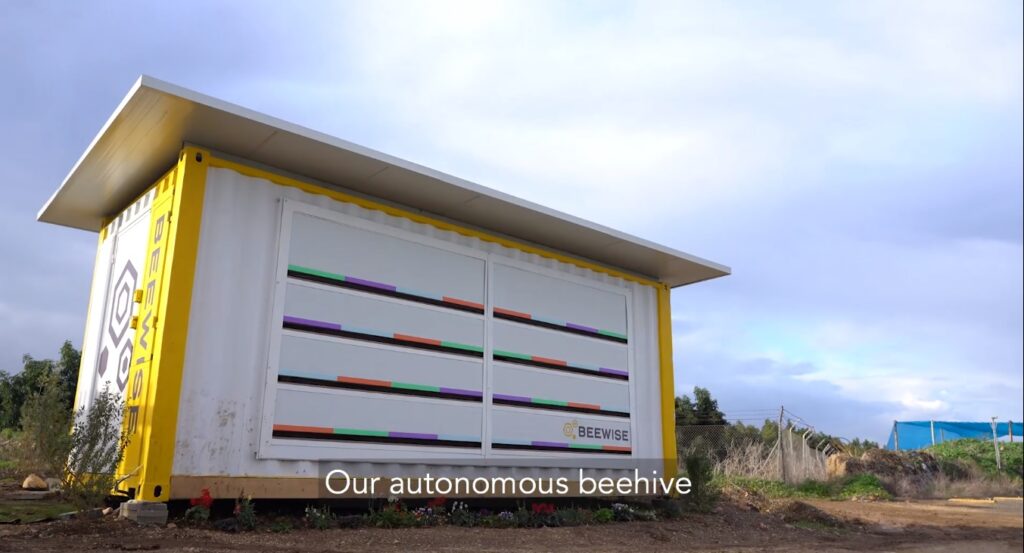
The Beehome is a welcome development in a world where global bee populations have been declining over the last few decades. Bee populations often face colony collapse disorder, which occurs when the majority of worker bees in a colony disappear and leave behind a queen and a few nurse bees to care for the queen and the remaining immature bees. This disorder, on top of excessive use of agricultural chemicals and climate change, has significantly reduced bee populations, yet agricultural production must grow by 70 percent by 2050 to avoid food scarcity.
Beewise raised $10 million in funding in July for its innovative solution.
Trialjectory – a guide to cancer trials
TrialJectory, a startup launched in 2017 with offices in Tel Aviv and New York, also appeared in the Ai category on TIME’s list. The company has set out to optimize clinical trial matching for cancer patients.
CEO and co-founder Tzvia Bader has had extensive experience in the high-tech sector, particularly in big data, and conceived of the idea for TrialJectory after her own struggle with cancer.
The service she helped develop uses AI algorithms to sift through a myriad of available trials and produce recommendations for patients looking to participates.
Patients can log in to the company website and submit information on their particular situations. Bader told NoCamels in 2018 that one of the difficulties with trial matching is that the criteria are “very specific,” differing on cancer type and phase as well as other features peculiar to each patient. She said TrialJectory is able to achieve such precision: “Based on the patient profile we have, we run an algorithm to find the right trials so instead of a list of a few hundred, you’ll end up with two, three, [or] five that are right for you.”
The company generates revenue from pharmaceutical companies running trials to which TrialJectory refers patients. “As a principle, our mission, part of our values, we don’t charge the patient,” Bader said at the time. After TrialJectory returns trial recommendations on a patient profile, the patient can select one. The company then contacts the pharmaceutical company running the chosen trial to arrange for participation.
Augmedics
Xvision by Israeli company Augmedics featured in the Augmented and Virtual Reality category of TIME’s list.
The device is an AR headset with goggles that projects an “x-ray vision”-like 3D visualization of the spinal anatomy of a patient in real-time for surgeons. This allows the surgeon to accurately navigate instruments and implants while looking directly at the patient, rather than at a remote screen.
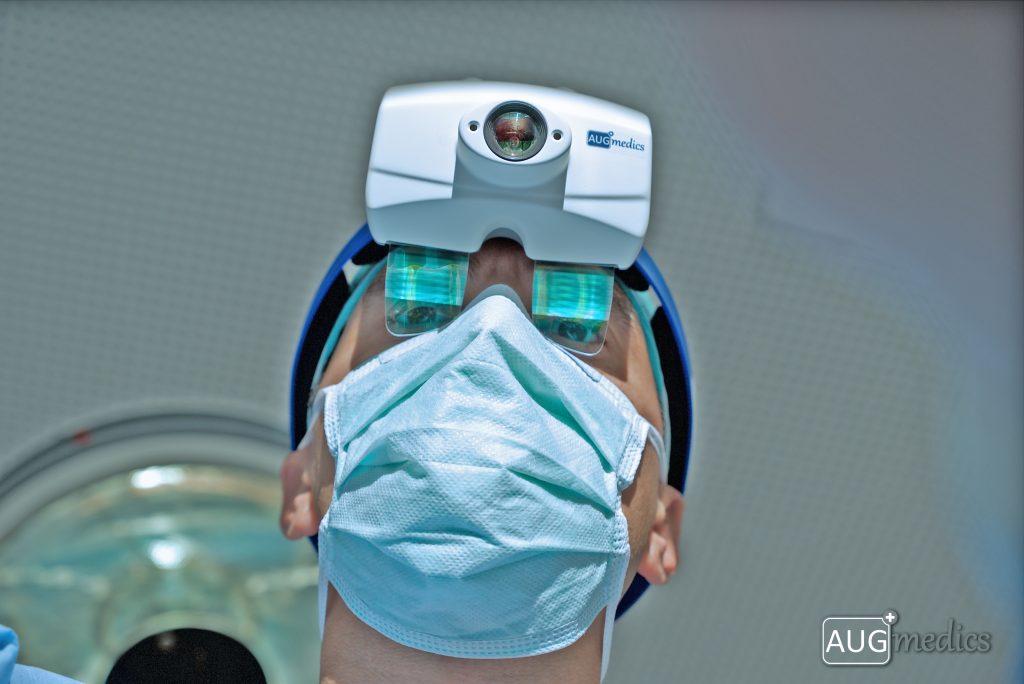
Augmedics was founded in 2014 by Nessi Benishti and Nissan Elimelech. The Xvision received 510(k) clearance from the US Food and Drug Administration last year.
“Augmedics’ mission is to give surgeons more control by creating technological advances that cater to their needs and fit within their workflow,” said Elimelech, who serves as CEO, at the time of the FDA announcement.
Sign up for our free weekly newsletter
“Xvision is our first product of many to follow that will revolutionize surgery, as it gives surgeons the information they need, directly within their working field of sight, to instill technological confidence in the surgical workflow and help them do their jobs as effectively and safely as possible,” he added.
The device is in use at top US hospitals like Johns Hopkins and Rush University Medical Center, TIME reported.
Mifold Hifold by Carfoldio
The parenting category of the TIME list of inventions featured the Mifold Hifold, a fit-and-fold car booster seat touted by the Israeli company behind it – Carfoldio – as the “world’s most compact, portable and adjustable highback booster.”
The Mifold Hifold has adjustable head, torso and seat panels – 243 individual settings in total – and offers seatbelt fit for children of all sizes from 33-100 lbs. (14-45 kg) and 36-59 inches (91.44 – 149.86 cm). The booster folds down to a compact and convenient size for storage, travel, and carpooling and is lightweight and convenient. TIME magazine called the seat a “Transformer-like device.”
TIME magazine has listed six Israeli-made innovations among its annual list of 100 Best Inventions of 2020 that are “changing how we live.” In 2019, the magazine featured nine Israeli innovations.
This year’s list was published late last week and features gadgets, devices, products, and services in multiple categories such as artificial intelligence, accessibility, electronics, augmented reality, design, finance, and entertainment. There is also a “special mention” category where one Israeli innovation was listed.
The magazine said the list was compiled through solicited nominations from TIME editors and correspondents around the world, and through an online application process. Each contender was then evaluated on key factors such as “originality, creativity, effectiveness, ambition, and impact.”
“The result: 100 groundbreaking inventions—including a smarter beehive, a greener tube of toothpaste, and technology that could catalyze a COVID-19 vaccine—that are changing the way we live, work, play and think about what’s possible,” the magazine wrote.
Among the best inventions were a power wheelchair accessory, a smart baby crib, an AR training platform for frontline workers, a made-to-order manicure service, a phone that doubles as a notebook by Microsoft, a robotic tutor, a vegan pork offering, and an indoor gardening solution.
Here are the six Israeli innovations that appear on the list:
Beehome, the first automated beehive created by Israeli startup Beewise, was listed in the artificial intelligence category.
Beehome is a solar-powered, retrofitted shipping container that can house up to 40 bee colonies in an automatically controlled climate for optimal humidity conditions that can be monitored via app. The beehome also has pest control functions that monitor for parasitic mites that can have detrimental effects on colonies. AI technology adjusts conditions in the Beehome when it identifies that a colony is preparing to swarm, and Beehomes send alerts to beekeepers once a container of honey reaches its 100-gallon capacity.
SEE ALSO: 7 Israeli Bee Tech Firms Protecting Bee Populations And Global Agriculture
All of these changing conditions ensure that yields improve, pollination occurs more efficiently, and bee populations are protected. Beehome costs $15 per month per hive.
Israeli company Beewise created an autonomous beehive. Screenshot
The Beehome is a welcome development in a world where global bee populations have been declining over the last few decades. Bee populations often face colony collapse disorder, which occurs when the majority of worker bees in a colony disappear and leave behind a queen and a few nurse bees to care for the queen and the remaining immature bees. This disorder, on top of excessive use of agricultural chemicals and climate change, has significantly reduced bee populations, yet agricultural production must grow by 70 percent by 2050 to avoid food scarcity.
Beewise raised $10 million in funding in July for its innovative solution.
TrialJectory, a startup launched in 2017 with offices in Tel Aviv and New York, also appeared in the Ai category on TIME’s list. The company has set out to optimize clinical trial matching for cancer patients.
CEO and co-founder Tzvia Bader has had extensive experience in the high-tech sector, particularly in big data, and conceived of the idea for TrialJectory after her own struggle with cancer.
The service she helped develop uses AI algorithms to sift through a myriad of available trials and produce recommendations for patients looking to participates.
Patients can log in to the company website and submit information on their particular situations. Bader told NoCamels in 2018 that one of the difficulties with trial matching is that the criteria are “very specific,” differing on cancer type and phase as well as other features peculiar to each patient. She said TrialJectory is able to achieve such precision: “Based on the patient profile we have, we run an algorithm to find the right trials so instead of a list of a few hundred, you’ll end up with two, three, [or] five that are right for you.”
The company generates revenue from pharmaceutical companies running trials to which TrialJectory refers patients. “As a principle, our mission, part of our values, we don’t charge the patient,” Bader said at the time. After TrialJectory returns trial recommendations on a patient profile, the patient can select one. The company then contacts the pharmaceutical company running the chosen trial to arrange for participation.
The device is an AR headset with goggles that projects an “x-ray vision”-like 3D visualization of the spinal anatomy of a patient in real-time for surgeons. This allows the surgeon to accurately navigate instruments and implants while looking directly at the patient, rather than at a remote screen.
Augmedics was founded in 2014 by Nessi Benishti and Nissan Elimelech. The Xvision received 510(k) clearance from the US Food and Drug Administration last year.
“Augmedics’ mission is to give surgeons more control by creating technological advances that cater to their needs and fit within their workflow,” said Elimelech, who serves as CEO, at the time of the FDA announcement.
“Xvision is our first product of many to follow that will revolutionize surgery, as it gives surgeons the information they need, directly within their working field of sight, to instill technological confidence in the surgical workflow and help them do their jobs as effectively and safely as possible,” he added
The device is in use at top US hospitals like Johns Hopkins and Rush University Medical Center, TIME reported.
The parenting category of the TIME list of inventions featured the Mifold Hifold, a fit-and-fold car booster seat touted by the Israeli company behind it – Carfoldio – as the “world’s most compact, portable and adjustable highback booster.”
The Mifold Hifold has adjustable head, torso and seat panels – 243 individual settings in total – and offers seatbelt fit for children of all sizes from 33-100 lbs. (14-45 kg) and 36-59 inches (91.44 – 149.86 cm). The booster folds down to a compact and convenient size for storage, travel, and carpooling and is lightweight and convenient. TIME magazine called the seat a “Transformer-like device.”

A second Israeli astronaut, former fighter pilot Eytan Stibbe, will take off to space to take part in a national, historic and scientific mission scheduled for the end of 2021. The announcement was made on Monday at a joint press conference hosted by Israeli President Reuven Rivlin and the Ramon Foundation together with the Ministry of Science and Technology.
Stibbe’s mission comes 18 years after the country’s first astronaut, Colonel Ilan Ramon, was sent to space and died alongside six fellow astronauts when their space shuttle broke up upon re-entry to Earth after a 16-day research mission in 2003.
This article was originally posted by NoCamels.com. See Featured article: Artificial Intelligence.
Follow Diane Israel on Facebook.
Follow Diane Israel on Instagram.
Follow Diane Israel on Twitter.
Connect with Diane Israel on LinkedIn.
Rivlin said the announcement of a second Israeli astronaut being sent to space was “a day of national celebration and immense pride.”
An Israeli pilot, with the blue and white flag embroidered on his uniform, is proving once again, as we have proved here over the last 72 years, that even the skies are no limit,” he said in his speech.
“The absence of Ilan, Rona and Asaf Ramon today reverberates in the heavens. The family is a source of true Israeli inspiration and pride,” he said, referring to the astronaut, his widow, Rona, a public activist, STEM influencer and supporter of the education and advancement of youth in Israel who died in 2018, and their son, Asaf, an F-16 pilot who died in a training accident in 2009.
Rona Ramon established the Ramon Foundation in 2010 and ran the organization until her death. Stibbe is also one of the founders of the Ramon Foundation and is a prominent veteran voluntary member of its board of directors. According to the Ramon Foundation website, Stibbe and Ilan Ramon flew together as fighter pilots.
The foundation runs advanced programs in the STEM fields, and encourages generation of Israelis toward academic excellence, and social leadership.
Stibbe is expected to launch from Florida to the International Space Station at the end of 2021, on behalf of the Ramon Foundation in partnership with the State of Israel.
His mission marks new territory in the private space industry.
The Israeli astronaut will be taking part in an international mission, initiated by Axiom Space, and which will be manned by two other private astronauts.
Stibbe will pay for the trip, the launch and all necessary equipment, according to a Haaretz report.
Stibbe is the founder and chair of Vital Capital Fund and, over the last 35 years, has worked on developing business and financing initiatives for projects in the developing world on vital infrastructure projects.
On arriving in space, Stibbe and a number of other astronauts will go to the International Space Station (ISS), pending NASA approval. The mission commander for Axiom Space is veteran US astronaut and VP of Axiom Space Michael López-Alegría, who has over 40 years of aerospace experience. He has flown to space four times and commanded the 14th ISS mission.
“Next year, I will have the opportunity to participate in a mission to the International Space Station – a fascinating mission to science, education and the exploration of human nature. The International Space Station is one of the greatest points of cooperation in the world, where astronauts from many countries live and work together. This is the kind of fellowship that is so vital, particularly at this time as we deal with the coronavirus crisis,” said Stibbe, a Colonel in the IAF reserves and who has logged 43 years as a fighter pilot.
“After the tragic loss of Ilan and Asaf, we created the Ramon Foundation with Rona to see how space research can heighten the senses, spark our curiosity and even challenge our wildest imagination. I hope that our mission to space will open new channels of cooperation, peace and believe in our ability to look after our beautiful planet for future generations,” he said at the press conference announcing the mission.
Minister of Science and Technology Yizhar Shai said the ministry was “proud to be a partner in the mission of the second Israeli astronaut, Eytan Stibbe, on a national mission that brings together the best brains of tens of thousands of children and adults, men and women, scientists and industrialists.
“The State of Israel is already considered a global power in the field of space. The mission of the second Israeli astronaut will contribute to the development of the New Space industry that will create tens of thousands of jobs and a new and important branch of the innovation and entrepreneurial economy,” he added.
The Ramon Foundation will lead all aspects of the Israeli mission – scientific and educational – together with the Ministry of Science and Technology and the Israeli Space Agency, which will lead the government ministry’s partnership, according to the announcement.
The plan calls for Stibbe to spend 200 hours at the ISS, during which he will perform a number of experiments using Israeli technology and scientific developments from researchers and startups that he will take with him to space.
He is also expected to bring the world of space to Israeli children.
Addressing the newest Israeli astronaut, Rivlin said: “My dear Eytan, up there, beyond the seventh heavens, you will do Israeli technological experiments, some of which have been developed by our young people. You will be the envoy of those brilliant brains, the present and future generations of Israeli research, and will help them understand how the world works when we look at it from afar. You will be Israel’s representative in a human effort to understand the wonderful workings that allow life on this planet, and uncover the secrets of the universe.”
The Ramon Foundation announced that in the three months before he blasts off, Stibbe will undergo a concentrated training period in the US, Germany and Russia.
“This mission to space, for science and research, on behalf of humanity’s unending search for knowledge, for discovery, for understanding, is being launched at a time when humanity is facing one of its greatest challenges. It is a crisis our generation has not known. Because of the virus, we have come to realize how many great concepts – like science, medicine and research – can fundamentally shake our lives,” said the president.
“We have come to realize how much we do not know, not only about distant planets and infinitely huge galaxies, but even here on our own small planet. Dealing with this microscopic, tiny virus, in an effort to find a vaccine, we must work together, scientists from different countries and peoples. That is the power of science. It reminds us that we are part of something much bigger, that speaks to the human spirit that is within us all,” said Rivlin.
“Go in peace and return in peace, and do not forget to wave to us from up there,” Rivlin signed off.
Diane Israel is a Chicago native and long-time supporter and advocate of the American Israel Public Affairs Committee (AIPAC). She is also famous for her culinary recipes. Diane can be reached at Diane@IsraelOnIsrael.com